How did Charlie get from aviation into commercial real estate?
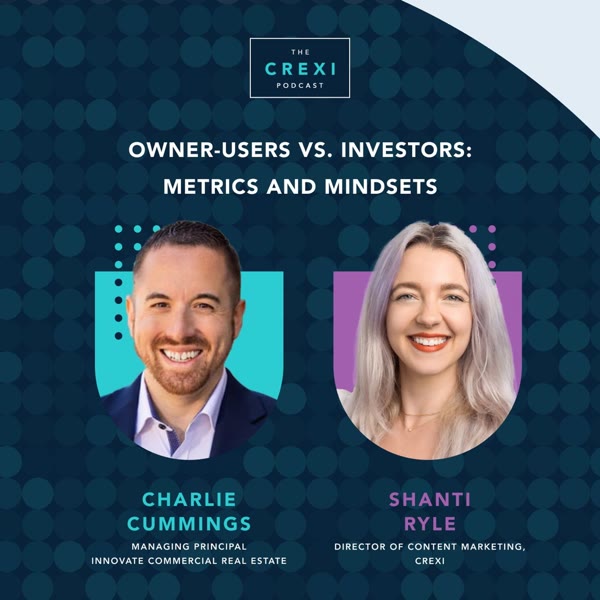
Shanti Ryle: Welcome, and thank you all for joining us on The Crexi Podcast, an insider's look at all things commercial real estate. I'm Shanti Ryle, Director of Content Marketing here at Crexi. Today we are very excited to sit down with Charlie Cummings, founder and managing broker of Innovate Commercial Real Estate. Charlie, welcome to the podcast.
Charlie Cummings: Thank you, Shanti.
Shanti Ryle: I'd love to hear your story in your own words. How did you get into commercial real estate in the first place, especially coming from aviation, and how did that evolve into launching your own company?
Charlie Cummings: I don't think a lot of people set out to be a commercial real estate broker. I certainly didn't. Through high school I wanted to be a commercial airline pilot. I went to college and decided that was not for me, so I majored in aviation management and became a consultant, solving the problems airports have. It's a little different from real estate, but it's still solving problems. I did that for about eight years, and after working for a very large firm I realized it was not a good fit anymore. Something was missing.
Charlie Cummings: I came back to Denver, talked to a friend in residential real estate at KW, and got my license. From there I aligned with a commercial real estate team in that office. After about a year of sitting in on those meetings, I realized there was a calling for me, not in residential but in commercial. The first year was very hard. But helping small businesses build a legacy is fundamental for me. It's something I couldn't really do in the airport world. I had always supported local businesses in my free time. Now I could do it as a profession.
Shanti Ryle: Can you share one of the first times you got to work with those business owners?
Charlie Cummings: One of the first groups I focused on was food trucks. I love food and I love restaurants, and there were hundreds of food trucks in Denver doing well. Some of them were converting to brick and mortar, wanting a permanent space where they could do year round business and catering. So I emailed them, called them and ran a consistent campaign. That's actually how I met my wife, through a food truck client.
Charlie Cummings: What I learned is that a lot of these owners went the food truck route because they didn't want the attachment to brick and mortar. Some businesses don't want to sign long term leases in retail centers. They want to go where the traffic is. Understanding how they operate helped me understand retail really well. And I've worked in every asset class in Denver, which is different from a lot of institutional shops where you pick one specialty. With the referrals I was getting, it was retail, multifamily, office, a whole spectrum of clients.
Why does integrity matter so much in brokerage?
Shanti Ryle: Do you have any early lessons learned or favorite mistakes from those first years?
Charlie Cummings: There was a referral for a multifamily owner I had been trying to reach for more than six months. When I finally got in front of him, he said, Charlie, you've got two months. As soon as we put it on the market we had offers within a week, and we closed in 45 days.
Charlie Cummings: What I learned through that process is that integrity is so important. I was the new person, and other brokers knew it. Being transparent, and not saying bad things about the other side just to win, taught me a lot. What we do creates wealth for our clients, but if it isn't communicated well and there isn't a good process, the impact on other people, like the tenants in a building, is not always great. Acting with integrity through all of it was crucial for me early on, and it's something I never want to let go of, no matter what is at stake.
Shanti Ryle: What do you think that owner saw in you that he didn't see in the other brokers?
Charlie Cummings: That deal was referred to me. A lot of the business I do comes from people who are one step closer to the client, so I wasn't a cold call. I came in through a relationship.
Charlie Cummings: Doing the right thing ethically is a question that keeps me up. You always see commercial real estate brokers share their closing rate. How many deals have they walked away from because it wasn't in their client's best interest? You don't see that shared a lot. That's really why I started Innovate CRE. I wanted to do something different in the marketplace. I think of people over profit. You can win together and build wealth, but it takes discipline and a focus on people.
How do TEDx and Toastmasters help a broker?
Shanti Ryle: Something I was fascinated by in our prep call was your involvement with TEDx and Toastmasters. How did you get involved, and what has the benefit been?
Charlie Cummings: I've always watched TED videos. If I'm going to have personal development time, it's watching TED. So I got involved as a volunteer with different TEDx events in Denver and the Colorado Springs area. Through that network I met a friend who ran a Toastmasters club, and once I went, I was hooked. It's a group of people from all walks of life working on something that's critical no matter what you do. Anything in your life has to do with communication.
Charlie Cummings: I took a leadership role with a chapter here for three years, and it had a huge impact on me personally and in commercial real estate. You're having conversations, sometimes really hard conversations. Knowing how to deliver that message, whether it's to a few people or a room, is critical. If somebody is going to invest in anything before they get into this business, I would say join a Toastmasters club. Learn public speaking, learn not to use filler words, learn to take deep breaths and pace yourself. Those soft skills have taken my career further.
What sets owner users apart from other investors?
Shanti Ryle: From your perspective, what sets the owner operator apart from other classes of investors?
Charlie Cummings: For the owner operator, their why is really critical. For some of the clients I work with, their family started the business, or they took over a generational partnership. They realize there's a lot at stake. It's not only the clients they serve. It's the employees and the impact they have. These are real people. If a local coffee shop is in need, they're going to go to their local chamber. A national chain is not going to the local chamber of commerce.
Charlie Cummings: I was talking to a broker last week and I can't get this image out of my head. Think of the Titanic and the band that kept playing as the ship was going down. That's the level of commitment. They weren't on the first boats out. Owners will fight and fight to keep their business going, and those are the people I want to be aligned with. This is everything to them.
Charlie Cummings: Yes, owner users sometimes pay more on a price per square foot basis. Their metrics are different from your typical investor. But seeing them build something for their community and their family propels every decision they make. Being a small part of that as their real estate strategist and advisor is fascinating to me. Ultimately it's their grit.
When should a business move from renting to owning?
Shanti Ryle: Where do you see that shift from, I'm going to rent this space, to, I'm going to own this space?
Charlie Cummings: When you look at how much lease rates have gone up, and especially in the current market, it's a great time to purchase. Whether you're an office, industrial or retail user, if there's an opportunity to get into the market, lock in and mitigate your risk, it's worth a look.
Charlie Cummings: I'm working with a client right now who is in the process of purchasing a five unit property where they will occupy one unit. We ran the numbers, and I said, your fixed mortgage is going to be offset by this rental income, and you're going to be in a better position in four, five, six years as you pay down the debt, with tenants offsetting some of the risk in your business. If there's an opportunity to own an asset that also reduces risk because other tenants are paying rent, that's huge right now.
Shanti Ryle: Say a tenant is ready to take the leap. What's the first step?
Charlie Cummings: In most cases these businesses have good relationships with their banks, and even their accountants are saying the same thing: you're in a really good position financially, you should look at buying a building. One of the things I try to do differently is build that team immediately when we meet with a client. Bring in your banker, your accountant and your attorney. If you don't have them, we have a great team we've vetted. We take that seriously, because they have to answer to us too. We're partners in this.
Charlie Cummings: It's not a decision made because Charlie thinks it's a good idea. It's because everybody on the team does. The client gets better results with more advisors in the room who have their best interests in mind.
Charlie Cummings: And think about the exits. If you own the business and the real estate, you have two assets. Before we sign a lease or buy a building, I ask, what's your exit? If you plan to exit in five years, what does that look like, and how does this real estate help or hinder it?
Shanti Ryle: Nationally there's a trend where generational property passes down to a next generation that wants nothing to do with the real estate. How do you see that play out?
Charlie Cummings: There are families who don't want to be involved, but waiting until the last hour is not the best strategy. Denver is an expensive market to build in, so existing properties have intrinsic value, whether they're vacant or occupied. I think it's important for the children or the partners of whoever owns it to be involved, and to look at it every year or two to see what the options are.
Charlie Cummings: It goes back to, why are you in this? What is it trying to fund for you, your family and your partners? If you look at that as a whole, you'll be in a better place than waiting for a death, a divorce or a dispute, which is usually not under good circumstances. Build a relationship with a broker who will stay involved with you quarterly or annually, and use them for knowledge and advice.
How is the next generation changing commercial real estate?
Charlie Cummings: Think about the boomer generation retiring and exiting. There's a big shift. I call it the next generation owner, broker and investor. That older generation was so guarded with data and information. The next generation operates very differently. They share more information on Crexi and other platforms, and there's an ease of doing business.
Charlie Cummings: What I'm trying to create is a white glove experience, because I believe information is becoming a commodity. If data on leasing and sales keeps getting better, then what makes me different from the next broker? It has to be service. The level of service and the user experience have to rise. With better systems, using AI and technology, and honestly just being more dialed in, you can create a better experience.
Shanti Ryle: Have you seen the next generation of investors and business owners doing things differently?
Charlie Cummings: I've worked in the last couple of years with second generation immigrant business owners, and things are more transparent. They value the relationship, and it's treated less as a commodity. For people in their 30s and 40s, relationship is really key. As much as we have our phones and our apps, when you're making a decision like buying a property, you want to know you can talk to Charlie. I'll give you all the tools if you want to dig in at 11 o'clock at night. But people still want a live connection.
Charlie Cummings: The next generation investor wants to know you really care, that you're not in this just for a commission, and that you put yourself in the investor's mindset. The best form of marketing is very simple: just care. Care about what you do and care about the people, and it will show. People can sense that when they meet you.
What is happening in the Denver market?
Shanti Ryle: Give me your 30,000 foot overview of Denver. What are your clients keeping their eyes on going into 2026?
Charlie Cummings: Denver is unique in that we have a very diverse economy, including a huge tourism economy. Like a lot of urban cores, Denver has struggled. It still has one of the highest office vacancies in the country. But the suburban Denver markets have done phenomenally.
Charlie Cummings: I have clients downtown, and I've seen how real the struggle is. I just had a client open a nightclub right in the core of downtown after a long, two year journey. The one thing those owners can do is band together and use the community. A client of mine in the suburbs shared something very vulnerable on Facebook: if things don't change, I'll be closing my doors in 45 days. The outpouring of support was huge. He will make it because he was vulnerable and shared. That's what I encourage for any small business that's struggling. Let people know, because people will come in to support you.
Charlie Cummings: Overall, I think Denver has hit a low point and we're heading into a rebound. People are coming back to the office, and bigger companies are mandating four days in. There are a lot of drivers that will keep making Denver a great place for companies to relocate, and for conventions, which haven't stopped. Policy can either help or hinder any city's trajectory. I'm bullish. Long term I see Denver in a really good place.
Shanti Ryle: I'm very long on community spaces. The younger members of our team at Crexi want to be in the office. They thrive off the energy.
Which AI tools help, and what can't they replace?
Shanti Ryle: Speaking of AI, you work across all these asset classes and you're involved in every part of the deal. Are there tools that make your life easier?
Charlie Cummings: This year I've gone down the rabbit hole on a lot of AI platforms. Some have worked and some haven't yet. One I use a lot is Gamma, which is not a commercial real estate tool, but it's great for creating something a client can digest, whether it's about a lease or a purchase or simply, here are our team partners. Another is a market survey tool. It takes listings from Crexi and CoStar, adds them to a survey, and the client gets one link where every property shows up, the costs are broken out, and they can like, dislike and comment. The days of printing out PDFs are over. You can do it on your phone, all in one place. And I use Terrakotta for dialing.
Charlie Cummings: The landscape changes so much. In a year, what's going to be the next great thing? You could spend a lot of time going down the rabbit hole. One thing I've learned is that no matter how much AI I use, is it really going to convince you to have a meeting with me about a property? That's where it all happens.
Charlie Cummings: We used to do discovery calls virtually and on the phone. Now we meet you on site, at your property or your place of business. Until somebody makes that investment of their time, we don't get a real sense of who they are. If they're an out of state investor, we make that compromise. But when I look at how many deals did not make it this year, in a lot of them there wasn't that in person connection. That's not going away in this business.
Charlie Cummings: You learn a lot when you visit somebody's place of business, including how they treat their employees. We want to work with people who treat their employees well.
What advice would Charlie give a new broker or investor?
Charlie Cummings: I'm also recording short videos with my clients and partners. Tell me your story, tell me why you got into this business, tell me about your first deal. How many times do you see a deal close and never see the person behind it, why they started the business and how they got there? I'm pushing to do more of that in the next 12 months.
Charlie Cummings: I learned this from my first mentor, Gary Best, who was at CBRE for a long time and at KW for the last part of his career. He always asked me, Charlie, what else can I do for you? That's how he treated me, and that's how he treated all his clients. He listened, and then he asked how he could help. Even if it's not related to the transaction, you never know where those little conversations will go. You've created value for somebody without trying to get anything out of it.
Charlie Cummings: I'm also running a commercial real estate mastermind in Denver for local broker owners. We started in the spring, and on average 10 to 12 people show up, with all levels of experience. Sometimes we're competitors and sometimes we're collaborating. Either way, we all have an abundant mentality that we're going to provide value for each other. We share the tools we're using and what works.
Shanti Ryle: Nobody makes it in this industry alone. What advice would you give a young broker, or a would be investor or business owner?
Charlie Cummings: Be of service. When I started, the business wasn't as collaborative as it is now, and I wasn't having the conversations I'm having today. A lot of people referred business to me because, as they put it, we can talk to you, you're approachable, and you make time to explain why something is a deal or not. I'd say the same to investors. Talk to other investors. Ask what has worked and what hasn't. If someone will give you 30 minutes of their time, that's great, and if they won't, move on to someone who will. Don't be scared to ask questions of people who know more than you, and try to provide value anywhere you can.
Shanti Ryle: Amen. I think that is a fabulous place to land the plane, taking us back to aviation. Where can people get in touch with you?
Charlie Cummings: I'm on Instagram, Facebook, LinkedIn and YouTube. Our brokerage is Innovate Commercial Real Estate, and you can find us at innovate-cre.com. We're approachable. If you get in touch with me, we will get back to you.
Shanti Ryle: In an in person meeting.
Charlie Cummings: Yes, an in person meeting.
This transcript of The Crexi Podcast, Episode 159 has been edited for length and clarity. The full conversation is in the episode, hosted by Shanti Ryle.